n8n development, and self-hosting it where the data cannot leave
What n8n is genuinely good at
The billing unit is the whole run. n8n counts one execution per workflow run, and its own documentation is explicit that the number of steps and the volume of data do not change that count. A workflow with four nodes and a workflow with forty cost the same to execute. On a platform that bills per action, those two are ten times apart.
That one fact decides most platform choices Keplify makes. The shape of problem n8n suits is a long pipeline that runs often: pull a batch of records, reshape them, branch on a dozen conditions, write to three places, log the result. Expressed in actions that is expensive everywhere else and flat here.
It runs where you put it. The self-hosted edition is free to download, and n8n's own documentation says a business can stay on the free community edition indefinitely. For a firm whose documents must not pass through a third party's infrastructure, that is not a cost argument. It is the only configuration that makes the automation permissible at all, and it is the same guardrails argument Keplify applies to AI pipelines, applied to hosting.
It expects code. n8n has a real JavaScript node, so the awkward ten percent of a workflow that is genuinely an algorithm lives inside the workflow instead of becoming a separate script in a separate system with its own credentials and its own way of failing.
Where n8n stops
Self-hosting is a server you now own. Patching, upgrades, backups, certificates and uptime monitoring move onto your side of the line. There is no vendor to call at two in the morning, and a failed upgrade is an outage of your own making. The honest version of "free to self-host" is that the software is free and the operational responsibility is the price.
Hosted tiers cap concurrency, not just volume. n8n's published entry cloud tier allows a small number of executions at the same time. A workflow triggered by a burst of webhooks does not fail, it queues, and a queue is a latency problem that only appears under the load nobody tested.
Fewer prebuilt integrations than the hosted platforms. For long-tail business software there is often no ready-made node, so the work is done with generic HTTP requests against the vendor's API. That is entirely workable and Keplify does it routinely, but it means authentication, pagination and error handling are built rather than inherited, and it is slower to build than clicking a module into place.
The licensed tiers phone home. n8n's self-hosted business tier requires a licence key that contacts n8n's licence server daily and reports production execution counts. That is a reasonable arrangement and it is worth knowing about before a security review discovers it, particularly for the firms most likely to want self-hosting in the first place.
Roughly what it costs to run
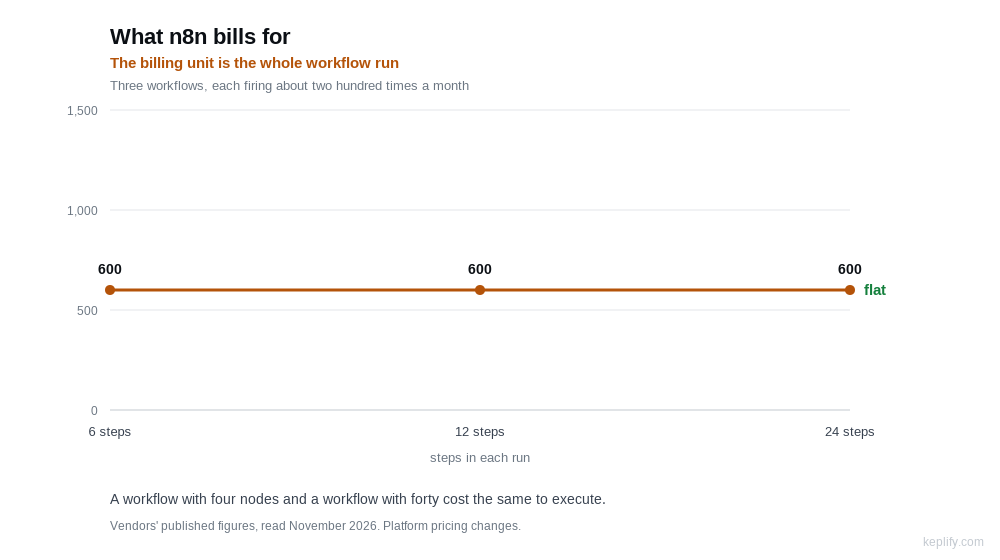
Take the same realistic small-firm load used on the Make page: three workflows, each firing about two hundred times a month, each averaging twelve steps per run. On n8n that is 600 executions a month, because the step count does not enter the arithmetic.
600 executions sits comfortably inside n8n's entry hosted tier, which was published at about 20 euros a month on annual billing for 2,500 executions when this page was written. The next tier up was about 50 euros for 10,000 executions. Those allowances are generous for a firm of this size precisely because of how an execution is counted.
Self-hosted, the software costs nothing and the infrastructure is a small virtual machine, on the order of $10 to $25 a month. That figure is also the one most often used to make self-hosting look cheaper than it is. The real cost is the maintenance, and a business should decide who is doing it before it chooses to own a server rather than after.
Platform pricing changes. These were the vendor's published figures in November 2026 and are worth checking before anybody plans a budget around them.
What happens when it breaks
An automation that silently stops is worse than a manual process, because nobody notices for a month. On a self-hosted stack there is one more way to fail than on a hosted one, so there is one more thing on this list.
What is tested before handover
Every branch, with real data, plus the cases a batch pipeline fails on that a single-record one does not: the empty batch, the partial page of results, the record that is already there, and the run that times out halfway through. A workflow that processes a hundred records has to be correct when it processes the hundred and first badly.
What runs in parallel, and for how long
The manual process stays in place for the first two weeks while the workflow runs beside it, and the two outputs are compared. For a migration from another platform, the old scenarios stay switched on and writing to a staging destination until the figures agree.
How a failure becomes visible
n8n keeps an execution log, and a log nobody reads is not monitoring. Every workflow Keplify builds has an error workflow attached that sends a message a human will see, naming the workflow and the record it failed on. Workflow definitions are exported into your own repository, so what changed is answerable.
How the instance itself is watched
This is the one a hosted platform does for you. A self-hosted n8n that is down produces no errors, because nothing is running to produce them. So uptime monitoring and a restart policy are part of the build, the version is pinned rather than tracking latest, and backups are configured and tested rather than assumed.
Who is called when a vendor changes an API
Keplify, quoted when it happens rather than carried on a monthly fee, because an automation on its own is not sold a care plan. Because much of the integration work here is direct against vendors' APIs rather than through prebuilt nodes, a deprecation is a change in your own repository rather than a wait for a platform to ship an update, which is slower to build and faster to fix.
A real automation is usually not one platform
Most of what Keplify delivers spans a platform holding the orchestration, code where the logic is genuinely algorithmic, and a feature inside a tool the client already pays for. n8n absorbs more of that than the hosted platforms do, because the code can live in the workflow, but it does not absorb all of it, and claiming otherwise would be a sales position rather than an engineering one.
Keplify has built an automation layer connecting marketing, delivery and internal communications for a professional services firm, including a working integration with a tool that had no public API at all. Hours of weekly manual reporting went to zero. Keplify does not name clients, and that includes yours.
What it costs to build
| Part | What it means | Price |
|---|---|---|
| An automation with no screens, first workflowSystems talking to each other, with no screens of their own | Systems talking to each other, with no screens of their own | $2,000 |
| Each workflow after the firstA second or third thing the same automation does | A second or third thing the same automation does | $1,000 |
| Connect a system with no APIThe one everybody told you was impossible | The one everybody told you was impossible | $2,750 |
One workflow: $2,000
One process automated end to end, tested against the manual version, documented, with its definition exported into your own repository. It is about a week.
Each one after that: $1,000
The second and third cost less because the instance, the credentials and the error handling already exist. If the first workflow also involves standing up a self-hosted instance, that setup is part of the first build rather than a separate line.
The full parts list is on the prices page, including what it costs to connect a system with no public API.
When Keplify would choose a different platform
n8n is the right answer less often than its advocates suggest. Three cases where Keplify would not use it:
When nobody should own a server, go to Make.For two or three modest scenarios at a firm with no technical staff, a hosted platform with a visual canvas is the better engineering decision even though the execution billing is less favourable. Saving $20 a month and acquiring a server to patch is a bad trade.
When the integration already exists everywhere else, go to Make. If every system in scope has a mature prebuilt module on a hosted platform and none on n8n, choosing n8n means paying for integration work that is otherwise free. That is only worth it if the execution arithmetic or the data residency argument pays for it.
When your own staff will maintain it, consider Zapier. n8n expects somebody comfortable with data structures and the occasional line of JavaScript. If the person inheriting this is an office manager, the simpler builder is sometimes right despite being the weaker tool.
Questions
- Should n8n be self-hosted or run on n8n Cloud?
- Cloud unless there is a reason, and there are two good reasons. The first is data: if the records moving through the workflows must stay inside infrastructure your business controls, self-hosting is the only answer that is actually true. The second is volume, where the execution allowances on the hosted tiers start to bite. Absent either, the hosted version removes a server you would otherwise have to patch, and that is worth more than it costs.
- Who maintains the server if n8n is self-hosted?
- Whoever is named in the scope document, and it is a question worth settling before the build rather than after. Self-hosting moves patching, upgrades, backups and uptime monitoring onto your side of the line. Keplify sets all four up as part of the build, documents them, and will keep doing them where that is written into the scope document, but an unowned server is the most common way a self-hosted automation stack quietly rots.
- What happens to workflows if an n8n upgrade goes wrong?
- On a self-hosted instance, that is your outage, which is why Keplify pins the version rather than tracking latest, keeps the workflow definitions exported into your own repository, and tests an upgrade before it touches the instance that runs the business. Workflows exported as files are also what makes a self-hosted instance recoverable rather than precious.
- Can Keplify move existing automations onto n8n?
- Yes, and it is a common reason to call. It starts with a $1,000 Blueprint reading what exists now, because a migration quoted without opening the current scenarios is a guess. Most migrations are driven by execution costs or by data residency, and the Blueprint says plainly whether the move actually solves the problem it is meant to.
Bring the workflow and the volume
Twenty minutes, no deck. Bring the invoice for the software you want to replace, or a description of what gets done by hand, and Keplify will do the arithmetic with you on the call.