What it costs
Four things businesses hire Keplify for
Each one is a real configuration with its parts listed, not a headline price. Seeing the addition is what makes the number credible.
An automation
Systems talking to each other. No screens: the work happens between tools you already pay for.
$2,000
about a week
- An automation with no screens, first workflow$2,000
An internal tool
Up to 5 screens, logins for your team, your own data.
$5,000
about 3 weeks
- An internal tool: 5 screens, logins, documentation, handover$5,000
A portal your clients use
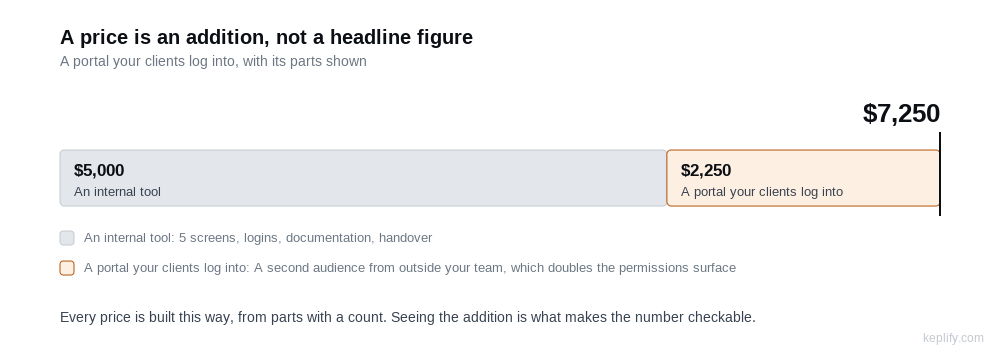
The internal tool, plus an outside audience with their own logins.
$7,250
about 4 weeks
- An internal tool: 5 screens, logins, documentation, handover$5,000
- A portal your clients log into$2,250
A document pipeline
Documents read, figures pulled out, and a person checking every one before it counts.
$11,000
about 6 weeks
- An internal tool: 5 screens, logins, documentation, handover$5,000
- Collect and store documents$1,500
- Read documents and pull the figures out, with a person checking every one$4,500
These are the shapes people ask for most. Anything else is built from the parts below.
If the document pipeline looks expensive next to the others, the reason is worth stating: the human review gate needs somewhere for the human to work, so a pipeline always carries screens. There is no cheap version of it, and pretending otherwise would be a teaser price.
The parts anything else is built from
A build is priced by counting what it contains. Start with the base, add the parts the work needs, and the total is the price.
| Part | What it means | Price |
|---|---|---|
| An internal toolUp to 5 screens, logins for your team, your own data | Up to 5 screens, logins for your team, your own data | $5,000 |
| Each screen after the fifthA list, a form, a dashboard or a detail view | A list, a form, a dashboard or a detail view | $750 |
| An automation with no screens, first workflowSystems talking to each other, with no screens of their own | Systems talking to each other, with no screens of their own | $2,000 |
| Each workflow after the firstA second or third thing the same automation does | A second or third thing the same automation does | $1,000 |
| Roles and permissionsDifferent people see and do different things, including a screen for managing who is who | Different people see and do different things, including a screen for managing who is who | $2,000 |
| Connect one system with a normal APIMost modern software | Most modern software | $1,500 |
| Connect a big CRM or ERPSalesforce, Dynamics, HubSpot, NetSuite | Salesforce, Dynamics, HubSpot, NetSuite | $3,250 |
| Connect a system with no APIThe one everybody told you was impossible | The one everybody told you was impossible | $2,750 |
| A portal your clients log intoA second audience from outside your team, which doubles the permissions surface | A second audience from outside your team, which doubles the permissions surface | $2,250 |
| Collect and store documentsUpload, chase, keep, find | Upload, chase, keep, find | $1,500 |
| Read documents and pull the figures out, with a person checking every oneThe guardrail pipeline | The guardrail pipeline | $4,500 |
| Reporting built around your numbersThe figures the business manages by, not the ones a tool shipped with | The figures the business manages by, not the ones a tool shipped with | $2,000 |
The price is the same if a tool needs no logins, because the rest of the foundation is identical.
Three more things, card payments, subscriptions, invoices, so another system can read and write your data, from a spreadsheet or an old system, come up rarely enough that they are priced on the call rather than listed here.
A price per screen is a price for a thing delivered, not a price for time. It does not change if the work takes longer.
What the screen count does not cover is a build whose hard part is the calculation rather than the screens. A commission engine is one screen and a great deal of arithmetic, and Keplify quotes that after a Blueprint rather than from this table.
A Blueprint, $1,000
Half a day on your systems and a written plan with a fixed price at the end of it. It is the way a build that cannot be priced from the table above gets a fixed price, and the fee comes off the build that follows.
How long it takes, and what happens if Keplify is wrong
- An automation
- about a week
- An internal tool
- about 3 weeks
- A document pipeline
- about 6 weeks
- A first version of a product
- about 6 weeks
The scope is agreed in writing before the work starts, and that scope is what ships. If Keplify has misjudged the work, the extra time is Keplify's cost, not yours. If the scope changes while the work is running, that is a new fixed price, agreed before anything is built.
Looking after it afterwards, from $163 a month
Once a build is handed over it still needs its dependencies patched and somebody to call when a vendor changes an API. Keplify will do that for 2.5 percent of the build a month, or you can do it yourself: every build is documented and runs in your own accounts. What the care plan covers, and what it does not.
The work, by category
For a reader who thinks in categories rather than in outcomes. Each group lists the pages that exist today.
Business process automation
From $2,000
The systems you already pay for, connected, so the work between them stops being done by people. Make.com, n8n, Zapier, Apps Script and direct API work, usually in combination rather than on one platform.
Internal tools that replace subscriptions
From $5,000
A purpose-built tool instead of a per-seat bill that rises every time you hire. The business case is the subscription you stop paying for, and it is arithmetic you can check before you buy anything.
AI automation
From $11,000
Documents read, figures pulled out, and a person checking every one before it counts. No number in the output comes from a model, and the human gate cannot be skipped.
Micro SaaS and product development
From $11,250
A small product of your own: sign-up, billing, the core workflow, yours to sell. Keplify has built two of these for itself, owns them, operates them and bills real customers through them.
Web
Site and integration work, priced from the same parts list as everything else.
No page of its own yet. The work is priced from the parts list above, and the call is twenty minutes.
Build it once, or rent it for ever
The business case for most of this work is a subscription that never stops and rises every time the business hires.
| Measure | Keep the subscription | Build it once |
|---|---|---|
| Up front | $0 | $12,000, a typical replacement build |
| Per month | $1,400, rising with headcount | $25, flat |
| Year 1 | $16,800 | $12,300 |
| Year 3, cumulative | $50,400 and rising | $12,900 |
| Payback | month 9 | |
| Where you are in year 3 | Still renting, still rising | Owned, documented, exportable |
A replacement build of $12,000 pays for itself inside a year once the software it replaces costs about $1,025 a month. Over two years the figure is $525 a month, and over three it is $358.
Below those bands, keep the subscription. What is worth replacing is the manual work around it: an automation at $2,000 pays for itself in a year against about 1.8 hours a week of somebody's time at $25 an hour, or about 1.1 hours at $40.
Below both, Keplify will say so. A build that does not pay for itself is not a sale worth making.
Taking over a system somebody else built
An automation account nobody understands, a developer who stopped answering, a system that works until it does not. Keplify takes these on, on any platform it works in.
It always reads the system first, as a $1,000 Blueprint, and what happens next comes out of what it finds. Nobody can quote for a system they have not opened.
The assessment is not credited against the work that follows, and that is worth saying plainly rather than leaving to be discovered: reading somebody else's system is the work, and the document is yours either way.
Sometimes the finding is that the system needs fixing before it can be looked after. The remediation is priced as a normal build, from the parts list above. Being told that beforehand is advice. Being told it afterwards would be an upsell, which is the whole reason it is on this page.
How engagements work
These are statements of fact about how Keplify works today, not intentions. If any of them changes, this page changes with it.
A written agreement first
There is a written agreement and an agreed scope before any work starts, governed by Delaware law.
You own the code
The client owns the code and the deliverables in full on final payment.
It runs in your accounts
The work runs in the client's own cloud accounts and repositories. Keplify builds into the cloud a client already pays for, including Google Cloud, at the same price. The hosting choice is the client's and it costs the same either way.
Access is yours to revoke
Access is granted by the client and can be revoked at any time.
Production data stays out of development
Production data is never used in development by default. Only when the client asks for it, and only when it is written into the scope document.
An NDA on request
An NDA is available on request.
Payment
Payment is 50 percent to start and 50 percent on acceptance. A Blueprint is paid up front.
What Keplify does not do
Equity instead of fees, or a technical co-founder
Keplify is paid for the work it does.
Staff augmentation, or a developer sitting inside somebody else's team
Keplify sells finished systems, not time.
Brand identity work, and SEO or marketing retainers
Keplify builds and integrates software. It does not run a brand or an ongoing marketing programme.
Work that needs somebody physically present, or work on hardware
Everything Keplify builds is reachable with access a client can grant remotely.
Large multi-year platform replacements
Keplify builds small systems quickly. A two-year enterprise migration is somebody else's work.
Anything whose deliverable is a slide deck rather than a working system
If nothing runs at the end of it, it is not a build.
Questions about price and scope
- What happens if the build runs over?
- The fixed price is Keplify's risk, not yours. If Keplify has misjudged the work, the extra time is Keplify's cost. The only thing that changes a price is a change you ask for, and that is agreed in writing before anything is built.
- Can a package be started without a Blueprint?
- Yes, for the smaller configurations. If what you need is close to one of the four examples above, the published price is the price and the work can start. A Blueprint at $1,000 is for the larger or less defined builds, where the scope has to be written down before a fixed price means anything. Its fee comes off the build that follows.
- What does Keplify need from you during a build, and when?
- Three things. At the start, access to the systems in scope and a decision-maker who can answer questions in a day rather than a week. In the middle, about an hour a week to look at what has been built and say whether it is right. At the end, somebody to accept the handover and read the documentation. A build stalls on access and on answers far more often than on engineering.
- What happens at the end of a build?
- The system runs in your cloud accounts, in your repositories, under credentials you control. You get written documentation covering how it works, where it runs and what to do when it breaks, plus 30 days of fixes after handover. Beyond that, a build with something connected to it can carry a care plan, priced as a proportion of the build and optional. An automation on its own is not sold one: a platform change there is quoted when it happens. Nothing Keplify builds needs Keplify in order to keep running.
- Will Keplify take over something another developer built?
- Yes, on any platform Keplify works in. It starts with a Blueprint, because nobody can quote for a system they have not opened. Sometimes the honest finding is that it needs fixing before it can be looked after, and the remediation is priced as a normal build.
Bring the invoice
Twenty minutes, no deck. Bring the invoice for the software you want to replace, or a description of what gets done by hand, and Keplify will price it against the table on this page while you are on the call.