Keplify builds the software you are currently renting
The problem is the renewal, not the software
Most businesses do not replace a subscription because the software is bad. They replace it because it fits about seventy percent of how the work is actually done, the other thirty percent is absorbed by people with spreadsheets, and the invoice arrives whether that gap closes or not.
Per-seat pricing is what turns that from an annoyance into a structural cost. The bill rises every time the business hires, which means the price of the software is indexed to the business's own success, and the gap the spreadsheets are covering never gets any smaller.
At $1,400 a month, three years of renting costs $50,400 and ends with nothing owned. The same three years of a build costs $12,900 and ends with a system, its documentation, and the data in a format the business controls.
The arithmetic, with the threshold stated
| Measure | Keep the subscription | Build it once |
|---|---|---|
| Up front | $0 | $12,000, a typical replacement build |
| Per month | $1,400, rising with headcount | $25, flat |
| Year 1 | $16,800 | $12,300 |
| Year 3, cumulative | $50,400 and rising | $12,900 |
| Payback | month 9 | |
| Where you are in year 3 | Still renting, still rising | Owned, documented, exportable |
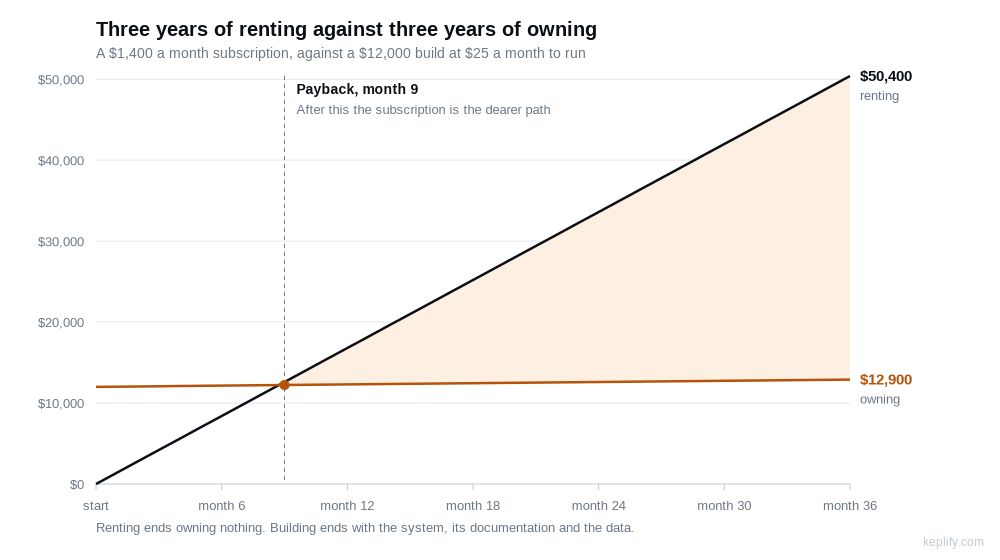
Payback lands in month 9. The threshold that matters is $1,025 a month: above that, a $12,000 replacement pays for itself inside a year. Over two years the threshold falls to $525 a month, and over three to $358.
The running cost in that table is $25 a month and it is measured rather than estimated: a static front end costs nothing to serve, so almost the whole bill is one managed database on a paid tier. Keplify does not quote a free tier, because a free database pauses when it is idle and a tool the business depends on cannot do that.
What Keplify builds instead
A purpose-built tool covering what the business actually does, in the cloud account the business already owns. The usual shape is a set of screens over a relational database with row-level isolation, logins for the team, roles deciding who sees what, the one or two systems that must stay connected wired in through their APIs, and the existing data moved across before anybody is asked to switch.
Keplify builds into the cloud a client already pays for, Google Cloud included, at the same price. The hosting choice is the client's and it costs the same either way, which means a replacement usually needs no new vendor, no new contract and nothing new for anybody to approve.
The old system stays running in parallel until the new one is trusted. A cutover is a decision the business makes once it has seen the numbers agree, not a date in Keplify's plan.
What it costs
A typical replacement, with its parts listed. The duration is derived from the same hours as the price.
A replacement build
Eight screens, roles and permissions, one system connected, and your existing data moved in.
$12,000
about 7 weeks
- An internal tool: 5 screens, logins, documentation, handover$5,000
- Each screen after the fifth, 3$2,250
- Roles and permissions$2,000
- Connect one system with a normal API$1,500
- Move your existing data in$1,250
Smaller than that: $5,000
Up to 5 screens, logins for your team, your own data. If five screens and logins cover the work, that is the whole price, and it is about 3 weeks.
Below the threshold: $2,000
If the software costs less than $1,025 a month, a rebuild is usually the wrong answer. The work worth removing is the manual work around it, and an automation starts at $2,000.
Not sure yet: a Blueprint, $1,000
Half a day on your systems and a written plan with a fixed price at the end of it. Its fee comes off the build that follows.
A replacement build is about 7 weeks.
When to keep the subscription
Three cases, and in all three Keplify will say so on the call rather than quote for a build.
- A low seat count. The arithmetic is driven by the monthly bill. Four seats on a per-seat tool rarely clears the threshold, and a rebuild would take years to pay for itself.
- A tool that genuinely fits. If the business uses most of what it pays for and the spreadsheets around the edges have gone, the subscription is doing its job. Rebuilding a good fit buys nothing but risk.
- A vendor doing product work you benefit from. Some subscriptions ship things the business would never build for itself, in a market that keeps moving. A replacement freezes the feature set on handover day, and sometimes that is the wrong trade.
A page that recommends buying in some cases is worth believing when it recommends building in others.
The proof
Keplify has retired a paid business intelligence subscription for a US professional services firm. The tool reported on the metrics it shipped with rather than the ones the business managed by, so the real numbers came out by hand. The replacement syncs the source system into a warehouse the client owns, archives raw snapshots so any past report can be rebuilt as it stood, keeps every credential in managed storage, and reports on the client's own metrics. Keplify does not name clients, and that includes yours.
The pattern generalises. Any CRM, practice management system or billing platform with an API can be synced into a warehouse the client owns and reported on properly, and the second one costs much less than the first.
For proof you can check yourself rather than take on trust, Keplify owns and runs SplitRE and CuspFlow. Both are live and both bill real customers. Both are open to the public: start a sign-up and watch the billing work. What was hard to build in each is written up.
What this is not
This is not a clone of the software being replaced. A rebuild that reproduces every feature of a product with a vendor's development budget behind it would cost more than renting it, and Keplify would not quote for one.
It is not a multi-year platform migration either. Keplify builds small systems in weeks. A two-year enterprise replacement is somebody else's work and the honest answer is a referral.
And it is not a licence. There is no per-seat fee, no renewal and no tier, which also means no vendor shipping new features to you next year. That trade is the subject of the section above.
Questions
- How is a build cheaper than a subscription when the subscription is a few hundred a month?
- Usually it is not, and that is the honest answer. The arithmetic turns over at about $1,025 a month: below that a build takes more than a year to pay for itself, and the subscription should stay. The exception is a tool whose per-seat price rises every time you hire, where the figure you should be comparing is next year's bill rather than this year's.
- What happens to the data in the system being replaced?
- It is exported and moved in, as a priced part of the build rather than an afterthought. Most vendors will export to CSV, and where one will not, the data comes out of its API. The migration is the part of a replacement that is routinely underestimated, so it is scoped before the work starts and the old system stays running in parallel until the new one is trusted.
- What if the subscription does something Keplify would not rebuild?
- That is common and it is worth finding on the call rather than in month two. A replacement is scoped around what the business actually uses, which is usually a fraction of what the vendor ships. Where something genuinely matters and is genuinely hard, the answer is sometimes to keep the subscription and automate around it instead.
- Who owns the result?
- You do. The work runs in your cloud accounts and repositories, under credentials you control, and the code and deliverables are yours in full on final payment. Every build is handed over with written documentation, so nothing about it depends on Keplify staying in the picture.
Bring the invoice
Twenty minutes, no deck. Bring the invoice for the software you want to replace, or a description of what gets done by hand, and Keplify will do the arithmetic with you on the call.