Professional services
An automation layer across three tool stacks
The problem
Marketing, delivery and internal communications lived in separate tools that did not talk to each other, and the connective work between them was done by people. Campaign results were copied into reports by hand. Project status was chased across three systems and summarised for a weekly meeting. Onboarding meant the same information typed into several places.
None of that is unusual. What made this one interesting is that one of the tools in the stack had no public API at all, so anything involving it was manual by definition. That single fact had quietly shaped how the whole business worked: processes were designed around the gap rather than across it, and the gap had stopped being questioned.
What Keplify built
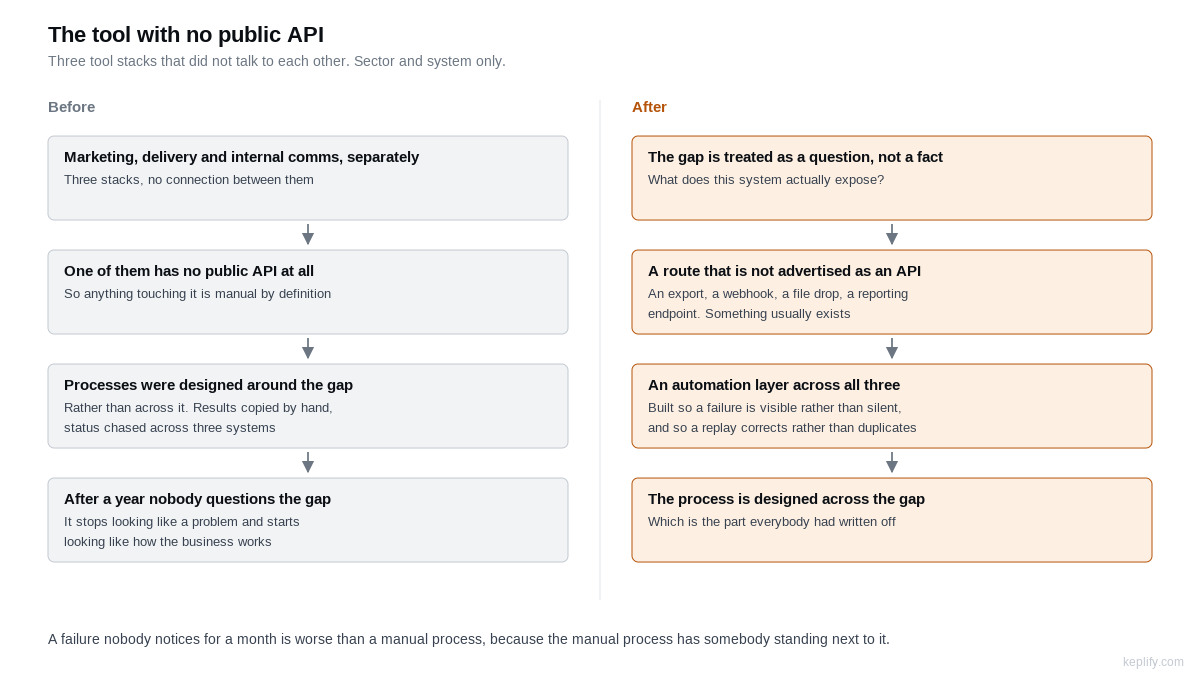
An automation layer connecting all three stacks end to end, built on Make.com with Google Apps Script where Make could not reach. Most of it is the ordinary work: a trigger in one system, a lookup, a decision, a write to two others, and a record of what happened.
The part worth describing is the tool with no public API. It was integrated anyway, which turned the one piece of the stack everybody had written off as permanently manual into part of the pipeline. That is usually the highest-value thing in an automation engagement, because it is the constraint every existing process has been bending around.
The mix is deliberate and worth stating plainly: a real automation normally spans a platform holding the orchestration, a script where the logic is genuinely algorithmic, and a feature inside a tool the client already pays for. Claiming one platform solves everything is a sales position rather than an engineering one.
The constraints that mattered
Maintainable by somebody who did not build it
Every automation is documented, and named so that a person opening the account in a year can tell what it does without tracing it. An automation nobody understands is a liability with a schedule attached.
Failures had to be visible
An automation that silently stops is worse than a manual process, because nobody notices for a month. Each one has a dedicated error route that sends a message a person will actually see, naming the automation and what it was processing when it stopped.
No credential outside managed storage
Connections are held by the platform or by a managed secret store, never pasted into a step. The alternative is a key sitting in a scenario that outlives the person who put it there.
The result
Hours of manual reporting every week went to zero. The weekly chase across three systems stopped being a task somebody owned, and the information that used to be re-typed during onboarding is now written once.
Keplify does not publish the exact hours recovered or the number of workflows built, because those figures have not been confirmed in a form that could be stood behind. What can be: the manual reporting was eliminated rather than reduced, and the integration everybody had assumed was impossible has been running since.
What it runs on
- Make.com
- Google Apps Script
- The APIs of the marketing, project management and communication tools involved
This is what an automation project looks like at the larger end, and the integration with the tool that had no API is the honest answer to the objection that your main system cannot be automated.
Keplify does not name clients, and that includes yours. This system is described by sector and by what was built, with nothing that identifies the client and no client intellectual property. The other case studies follow the same rule.
Bring the process that looks like this one
Twenty minutes, no deck. The second system of a given shape costs considerably less than the first, because the hard decisions in it have already been made once.