Make.com automation, built to be maintained by somebody who did not build it
What Make is genuinely good at
Make is a visual canvas with real control flow. A scenario can split down two routes on a condition, iterate over an array, aggregate the results back into one bundle and carry on. That is the difference between automating a process and automating a single step, and it is why Make handles the shapes that defeat simpler builders.
The shape of problem it suits: a form arrives, and depending on what is in it the work goes one of three ways, each one touching two or three systems, with the records that already exist updated rather than duplicated. That is four or five decisions inside one run. On Make it is one scenario a person can look at and understand. Expressed as a chain of separate single-trigger automations, it becomes a system nobody can reason about.
Its data-transformation functions are also a genuine strength. Dates, text and arrays can be reshaped inside the scenario, which removes the most common reason to add a script to an automation at all.
Where Make stops
It bills per action, so the cost of a scenario is its step count. Make charges a credit for each module action in a run, and most actions consume one credit. A twelve-module scenario firing two hundred times a month is about 2,400 credits. This is the single most important thing to understand about running on Make, and it has a direct design consequence: an elegant scenario with many small modules can cost several times what a blunter one with fewer calls costs to run. Keplify designs for the credit count, not just for the diagram.
Credits expire and running out is an outage. Unused credits expire at the end of the term. When the balance hits zero, scenarios stop, and incoming webhooks queue only up to a limit before they are lost. Extra credits can be bought in bundles, with a surcharge on top of the plan rate, and auto-purchase is available on some plans. A credit balance nobody is watching is therefore a scheduled failure, which is why it is part of what Keplify hands over.
It is not a place to put real code. Make has functions, not a runtime. Anything that is genuinely an algorithm belongs in a script the scenario calls, and Keplify will say so rather than building a twenty-module workaround for something that is nine lines of JavaScript.
A vendor changing an API is your problem, not Make's. When an app updates its API or deprecates an endpoint, Make updates its module on its own schedule. The gap between those two dates is a working scenario silently doing nothing, which is what the next section is about.
Roughly what it costs to run
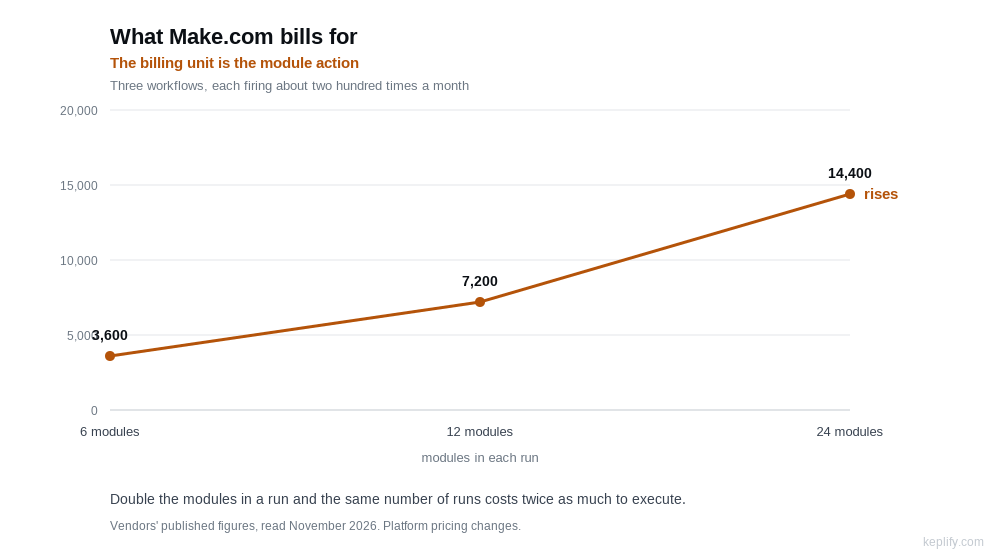
Take a realistic small-firm load: three scenarios, each firing about two hundred times a month, each averaging twelve modules per run. That is roughly 7,200 credits a month.
Make's free tier is 1,000 credits a month, so that load needs a paid plan, and 7,200 credits sits inside the entry paid tier, which was published at under $15 a month on annual billing when this page was written. In other words the platform subscription for a genuinely useful automation at this scale is a rounding error next to the time it removes.
The figure that actually varies is step count, not run count. Double the modules per run and the same two hundred runs cost twice as much to execute. That is why Keplify states the expected credit consumption as part of the handover rather than leaving the first surprising invoice to introduce the subject.
Platform pricing changes. These were the vendors' published figures in November 2026 and are worth checking before anybody plans a budget around them.
What happens when it breaks
An automation that silently stops is worse than a manual process, because nobody notices for a month. This block is not a footnote.
What is tested before handover
Every route through the scenario, with real data, including the ones that are supposed to do nothing. The cases that get skipped are the empty response, the duplicate record and the malformed input, so those are the ones written into the test list first.
What runs in parallel, and for how long
The manual process stays in place for the first two weeks while the scenario runs beside it, and the two outputs are compared. Nobody turns a process off on the strength of a successful test run.
How a failure becomes visible
Make keeps a run history, and on its own that is a log nobody reads. So every scenario Keplify builds has a dedicated error route that sends a message a human will actually see, naming the scenario and what it was processing. The credit balance is alerted on separately, because a scenario that has stopped for lack of credits produces no errors at all.
Who is called when a vendor changes an API
Keplify, and it is quoted when it happens rather than carried on a monthly fee: an automation on its own is not sold a care plan, and a platform change to one scenario is usually well under an hour. Either way the handover includes documentation covering what each scenario does, which systems it touches and what to check first, so the answer is never that nobody can tell.
A real automation is usually not one platform
Most of the automation Keplify delivers spans three things: a platform holding the orchestration, a script where the logic is genuinely algorithmic, and a feature inside a tool the client already pays for. Claiming one platform solves everything is a sales position rather than an engineering one.
Keplify has built an automation layer connecting marketing, delivery and internal communications for a professional services firm, on Make with Google Apps Script where Make could not reach. That included a working integration with a tool that had no public API at all, which turned the one part of the stack everybody had written off as manual into part of the pipeline. Hours of weekly manual reporting went to zero. Keplify does not name clients, and that includes yours.
What it costs to build
| Part | What it means | Price |
|---|---|---|
| An automation with no screens, first workflowSystems talking to each other, with no screens of their own | Systems talking to each other, with no screens of their own | $2,000 |
| Each workflow after the firstA second or third thing the same automation does | A second or third thing the same automation does | $1,000 |
| Connect a system with no APIThe one everybody told you was impossible | The one everybody told you was impossible | $2,750 |
One process: $2,000
One process automated end to end, tested against the manual version, documented, and running in your own Make organisation. It is about a week, and it is the cheapest thing Keplify sells.
Each one after that: $1,000
The second and third processes cost less because the connections, the credentials and the error handling already exist. Most clients start with one and add the next two once the first has been running for a month.
The full parts list is on the prices page, including what it costs to connect a system with no public API.
When Keplify would choose a different platform
A Make page that never recommends anything else is an advertisement. Three cases where Keplify would not build this on Make:
When runs are long and frequent, go to n8n. Make bills per action and n8n bills per workflow run, regardless of how many steps that run contains. A thirty-step workflow firing thousands of times a month is the case where that difference stops being academic and starts being the whole budget.
When the data cannot leave your infrastructure, go to n8n.Make is hosted, so the data passes through it. For a firm whose documents must stay inside its own cloud account, a self-hosted workflow engine is the only honest answer.
When your own team will own it afterwards, consider Zapier. Make's canvas is more powerful and correspondingly less forgiving. If the person maintaining this in a year is an office manager rather than a developer, the simpler builder is sometimes the right engineering decision even though it is the weaker tool.
Questions
- Does Keplify work in an existing Make account or a new one?
- Your own, always. The scenarios are built in your Make organisation, under your billing, with Keplify's access granted by you and revocable at any time. An automation living in a developer's account is the single most common reason a working automation becomes unmaintainable, and it is not something Keplify does.
- What happens to the credits if a scenario goes wrong?
- A failing module still consumes the credit for the actions that ran before it, which is why a scenario that errors in a loop is also a scenario that empties a credit balance. Keplify builds a dedicated error route rather than letting a scenario retry blindly, and sets the alert on the credit balance rather than waiting for scenarios to stop.
- Can Keplify take over scenarios somebody else built?
- Yes, on Make and on the other platforms. It starts with a $1,000 Blueprint, because nobody can quote for a scenario they have not opened, and inherited automation is usually part documentation problem and part design problem. Sometimes the finding is that it should be rebuilt rather than patched, and that is priced as normal work.
- Is Make the right platform for this?
- Sometimes not, and the section on this page about choosing something else is the honest version of that answer. Make suits branching, iteration and visual scenarios at moderate step counts. Where a run has a great many steps, where the data cannot leave your own infrastructure, or where your own team will maintain it without help, one of the other two is the better recommendation.
Bring the process that gets done by hand
Twenty minutes, no deck. Bring the invoice for the software you want to replace, or a description of what gets done by hand, and Keplify will do the arithmetic with you on the call.