Keplify builds AI pipelines with a human gate at every stage
The constraints, which are the product
Any vendor can put a model in front of a document. The work is in deciding what the model is not allowed to do, and these five rules are what Keplify builds to.
01
No number comes from the model
Every figure in the output is produced by deterministic calculation. The model finds and classifies. Arithmetic is code, and code can be tested, re-run and audited.
02
Every citation is verified against its source before a reviewer sees it
A claim whose citation does not resolve never reaches a human. Reviewers spend their attention on judgement rather than on catching invented references, which is the failure mode that quietly destroys trust in one of these systems.
03
A human gate at every stage, and it cannot be skipped
Extraction is proposed, never applied. Nothing becomes a fact in the system until a person has accepted it, and each decision is recorded with who made it and when.
04
Personal data is masked before it reaches anything that does not need it
Masking happens upstream of the model layer rather than being promised in a policy, so the components that never needed the personal data never receive it.
05
The audit trail cannot be edited after the fact
What was extracted, what changed, who approved it and when. An append-only record is the difference between a system a professional can sign for and one they cannot.
The problem this solves, and the one it creates
A firm whose people spend hours reading client documents and pulling the same fields out of each one has an obvious candidate for automation, and an obvious risk in automating it. The business cannot sign its name to a figure it cannot trace. A system that is usually right is not an improvement on a person who is slow, because the error arrives without a signal attached to it.
So the design question is not how accurate the model is. It is where the output stops being a suggestion and starts being a fact, who makes that happen, and what record exists afterwards. Get that wrong and the firm has moved its liability onto a model's output while believing it has saved time.
Keplify builds the stopping point first and the extraction second. That is the whole difference between these systems and a demonstration.
What Keplify builds
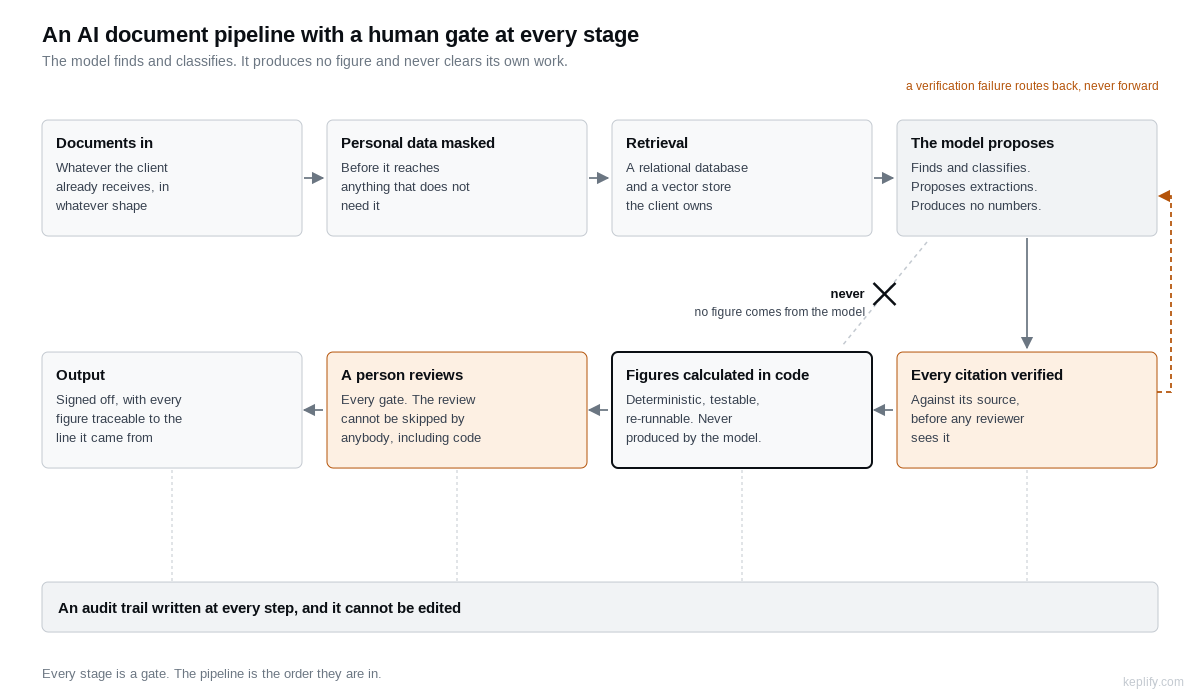
Documents arrive, are classified, and are routed through specialised agents that each have one job, orchestrated so that the sequence is explicit rather than emergent. Retrieval spans a relational database and a vector store, so a claim can be traced to the passage it came from rather than to a similarity score.
Extraction produces candidate fields, each with a citation. Citations are resolved against their source before anything reaches a person. Figures are computed in code from the extracted values rather than generated. A reviewer sees the candidates beside their sources, accepts, corrects or rejects each one, and only then does the output exist as data the business can use.
Everything that happened is recorded in an append-only trail. Secrets live in a managed secret store, never in a script. Access is the minimum the pipeline needs, in the client's own cloud account.
Your cloud accounts, your repositories, your credentials, with written documentation at handover.
What it costs
One configuration, with its parts listed, because the parts are what explain the number.
A document pipeline
Documents read, figures pulled out, and a person checking every one before it counts.
$11,000
about 6 weeks
- An internal tool: 5 screens, logins, documentation, handover$5,000
- Collect and store documents$1,500
- Read documents and pull the figures out, with a person checking every one$4,500
Why there is no cheaper version
The human review gate needs somewhere for the human to work, so a pipeline always carries screens. The $5,000 base is not an optional extra on top of the interesting part. It is where the interesting part is checked.
Collecting documents only: $6,500
If the problem is chasing documents rather than reading them, the pipeline is not needed. An internal tool with upload, chase, keep, find is the smaller build, and it is often the one that removes the most work.
Scoping first: a Blueprint, $1,000
Document work is where estimates go wrong, because the documents are never as consistent as anybody remembers. Half a day on your systems and a written plan with a fixed price at the end of it, and the fee comes off the build.
A pipeline is about 6 weeks.
The proof
Keplify built a multi-agent document pipeline for a US financial services firm. Analysts had been reading client documents, pulling the same fields out of each one and then checking each other's work. The pipeline routes documents through specialised agents over a retrieval layer that spans a relational database and a vector store. The agents propose extractions and verify every citation against its source before a reviewer sees it. Every figure in the output is produced by deterministic calculation, not by the model. A human reviews every gate, and the system is built so the review cannot be skipped.
It runs on managed cloud infrastructure in the client's own account, with personal data masked before it reaches any component that does not need it and an immutable record of what was extracted, what changed, who approved it and when. Keplify does not name clients, and that includes yours.
What this is not
This is not a system that decides anything. Every output is a proposal until a person accepts it, and Keplify will not build a pipeline that writes to a system of record without a human in the path, however much time that would appear to save.
It is not a chatbot over your documents. A retrieval interface that answers questions in prose is a different product with a different risk profile, and it is not what this page is about.
It is not a model Keplify trains on your data. The pipeline uses commercial models through their APIs, under the client's own accounts and agreements, and the engineering is in the constraints around them.
Questions
- A vendor says their model is 95 percent accurate. Is that good?
- It depends entirely on what happens to the other five percent, and that is the question worth asking. On a hundred documents a month, 95 percent accuracy is five wrong figures going somewhere. If a person checks every output, the accuracy figure describes how much work the system saves. If nothing checks the output, it describes how often the business is wrong without knowing it. Ask where the review gate is, not what the percentage is.
- Does the model see client data?
- Only what it needs, and only where the engagement is about that. Personal data is masked before it reaches any component that does not require it, access is restricted to the client's own accounts, and production data is never used in development by default: only when the client asks for it and it is written into the scope document.
- Why does a pipeline cost more than an internal tool?
- Because it contains one. The review gate needs somewhere for the human to work: a queue, a document view, the extracted fields beside their citations, and a record of every decision. That is an application, so a pipeline is the $5,000 base plus the document handling plus the reading and review on top of it. There is no cheaper version, and a price that implied otherwise would be a teaser.
- What happens when the documents change shape?
- They will, and a pipeline that assumes otherwise fails silently. Extraction is built around finding fields rather than reading fixed positions, unrecognised documents are routed to a person instead of guessed at, and the rate at which that happens is visible rather than buried. A pipeline nobody is watching is worse than the manual process it replaced.
Start with the documents you have
Twenty minutes, no deck. Bring the invoice for the software you want to replace, or a description of what gets done by hand, and Keplify will do the arithmetic with you on the call.