Professional services, in the US
The pipeline that retired a reporting subscription
The problem
The business ran its delivery work in one system and paid a monthly subscription for a business intelligence tool to report on it. On paper that is the correct arrangement, and for a while it was.
The problem was what the paid tool reported on. It reported on the metrics it shipped with rather than the ones the business managed by, which meant that getting the real numbers out involved exporting data and finishing the job by hand. The firm was paying every month for reports nobody trusted enough to put in front of a partner, and then doing the work again in a spreadsheet.
That is the shape of problem this site exists for. The subscription was not bad software. It was software that fit most of the workflow, with the remainder absorbed by people, and an invoice that arrived whether the gap closed or not.
What Keplify built
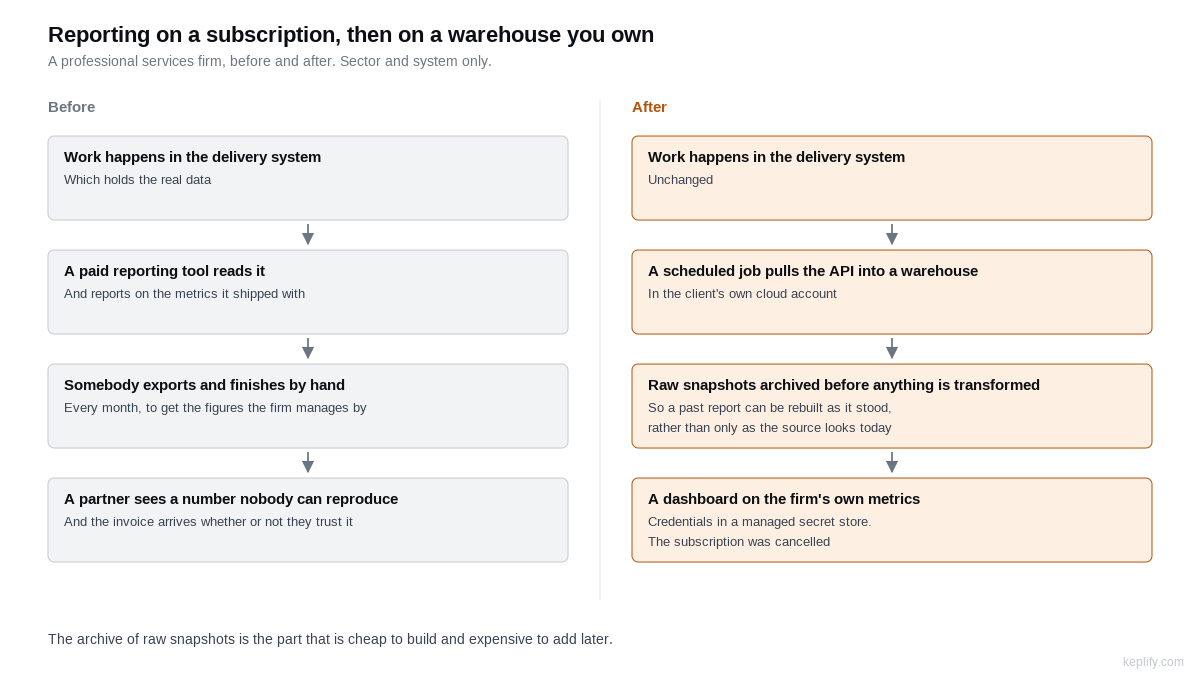
A scheduled pipeline and a dashboard the client owns. Cloud Scheduler triggers Cloud Run jobs that pull the source system's API into BigQuery on a schedule. Raw snapshots are archived to Cloud Storage before anything is transformed. API tokens live in Secret Manager. The dashboard is served from Firebase Hosting behind Firebase Auth and is built around the client's real metrics rather than a vendor's defaults.
The archive of raw snapshots is the part that is easy to leave out and expensive to add later. Without it, a report can only ever be rebuilt as the source system looks now, which means a question about last quarter has no defensible answer.
The constraints that mattered
Numbers had to be reproducible after the fact
Which is why raw snapshots are archived and not only the transformed tables. A report can be rebuilt as it stood on any past date rather than only as the source system looks today, and that is the difference between a dashboard and a record.
No credential in a script or a spreadsheet
Every API token lives in a managed secret store. The most common way a reporting pipeline becomes a security problem is that it starts life as somebody's scheduled script with a key in it.
Access limited to the client's own accounts
The warehouse, the jobs, the storage and the dashboard all sit inside cloud accounts the client owns, under credentials the client controls and can revoke.
Running cost materially below the subscription it replaced
Scheduled batch jobs on managed infrastructure make that straightforward: the compute scales to zero between runs, so an idle pipeline costs almost nothing to own.
The result
The subscription was cancelled. Reporting moved from a monthly fee plus manual export work to a scheduled job the client owns outright, running on infrastructure that costs a small fraction of what the tool did.
Keplify does not publish the subscription's price, the annual saving or the reporting hours recovered, because those figures have not been confirmed in a form that could be stood behind. The claim that can be stood behind is the one above: the tool was retired, and the reports it used to produce badly are now produced from data the business owns.
What it runs on
- Cloud Scheduler
- Cloud Run jobs
- BigQuery
- Cloud Storage
- Secret Manager
- Firebase Hosting
- Firebase Auth
The pattern generalises. Any CRM, practice management system or billing platform with an API can be synced into a warehouse the client owns and reported on properly, and the second one costs much less than the first.
Keplify does not name clients, and that includes yours. This system is described by sector and by what was built, with nothing that identifies the client and no client intellectual property. The other case studies follow the same rule.
Bring the process that looks like this one
Twenty minutes, no deck. The second system of a given shape costs considerably less than the first, because the hard decisions in it have already been made once.