Financial services, in the US
A document pipeline a professional can sign
The problem
Analysts spent hours reading client documents and pulling the same fields out of each one, then checking each other's work. It is the kind of task that looks like an obvious candidate for automation right up to the moment somebody asks what happens when the automation is wrong.
Because the obvious fix was also the obvious risk. A firm cannot sign its name to a figure it cannot trace, and a model that is right most of the time is a liability where being wrong is a professional matter rather than an inconvenience. An error that arrives with no signal attached to it is worse than a slow process, because nobody is looking for it.
So the design question was never how accurate the extraction could be. It was where the output stops being a suggestion and starts being a fact, who makes that happen, and what record exists afterwards.
What Keplify built
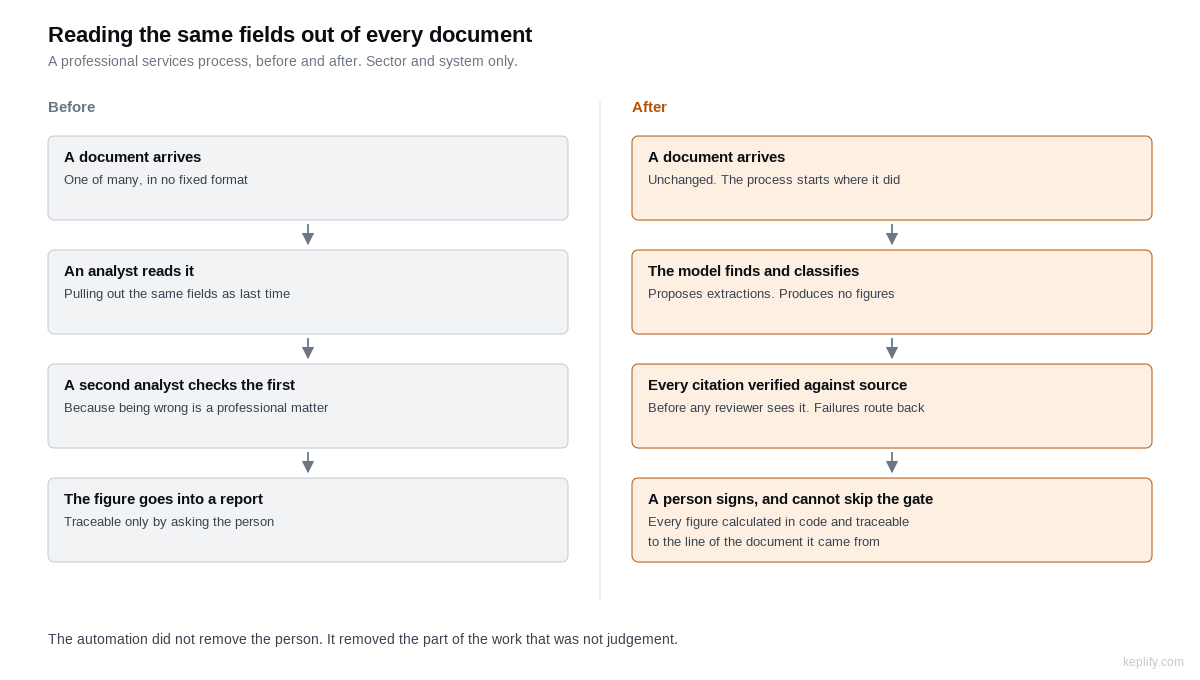
A multi-agent document pipeline. Documents are routed through specialised agents orchestrated with LangGraph, each with one job, over a retrieval layer spanning a relational database and a vector store. That split matters: a claim can be traced back to the passage it came from rather than to a similarity score.
Extraction produces candidate fields, each carrying a citation. Citations are resolved against their source before anything reaches a person. Figures are computed in code from the extracted values rather than generated. A reviewer sees the candidates beside their sources, accepts, corrects or rejects each one, and only then does the output exist as data the business can use.
The stopping point was built first and the extraction second. That order is the whole difference between this system and a demonstration.
The constraints that mattered
No number comes from the model
Every figure in the output is produced by deterministic calculation. The model finds and classifies; the arithmetic is code, which can be tested, re-run and audited. This is the constraint the whole design is built around, and it is the one a firm's professional liability actually rests on.
Every citation is verified against its source before a reviewer sees it
A claim whose citation does not resolve never reaches a person. Reviewers spend their attention on judgement rather than on catching invented references, which is the failure mode that quietly destroys trust in a system like this one.
A human gate at every stage, and it cannot be skipped
Extraction is proposed, never applied. Nothing becomes a fact in the system until somebody has accepted it, and every decision is recorded with who made it and when.
Personal data is masked before it reaches anything that does not need it
Masking happens upstream of the model layer rather than being promised in a policy, so the components that never needed the personal data never receive it.
Access is restricted and the audit trail is immutable
What was extracted, what changed, who approved it and when. An append-only record is the difference between a system a professional can sign for and one they cannot.
The result
The pipeline runs in the client's own cloud account, and the review step that was previously two analysts checking each other's reading is now one person confirming or correcting a proposal that arrives with its sources attached.
The honest version of the outcome is that the saving is in the reading rather than in the judgement. The judgement is still a person's, and that was the point. Keplify does not publish a time-saved figure for this system, because the one that could be quoted has not been measured, and an estimate presented as a measurement is the sort of claim this entire page argues against.
What it runs on
- LangGraph for orchestration
- Postgres
- A vector store for retrieval
- Google Cloud for compute and storage
- Claude and Vertex AI for the model layer
- A managed secret store
Any vendor can put a model in front of a document. The work is in deciding what the model is not allowed to do.
Keplify does not name clients, and that includes yours. This system is described by sector and by what was built, with nothing that identifies the client and no client intellectual property. The other case studies follow the same rule.
Bring the process that looks like this one
Twenty minutes, no deck. The second system of a given shape costs considerably less than the first, because the hard decisions in it have already been made once.