Care plan
Keeping it working after it ships
2.5 percent of the build a month. On a $12,000 build that is $300 a month. One plan, no tiers, and nobody has to buy it.
Hosting is not in that figure and never will be. The work runs in your cloud accounts under credentials you control, so the platform bill, about $25 a month, is yours and is the same whether or not you take a plan.
The price is a proportion, not a number
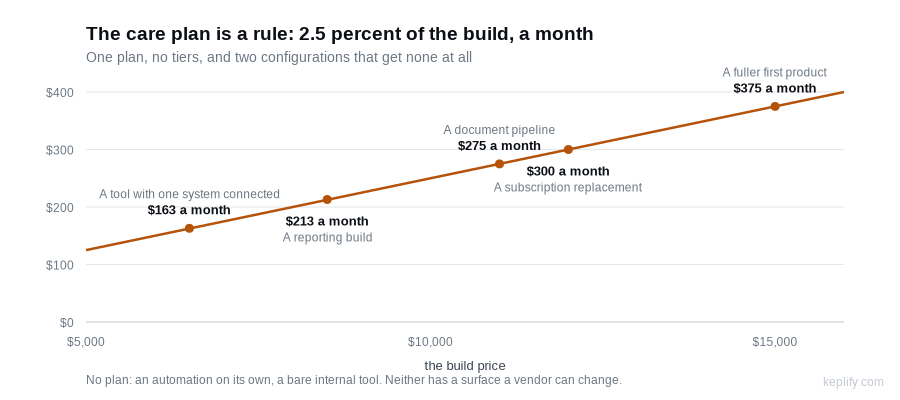
Care costs 2.5 percent of what the build cost, every month. A bigger build is not charged more because it was expensive. It is charged more because there is more of it exposed to the outside world, and every integration, portal and pipeline is one more thing a vendor can change underneath you. The parts list already prices those surfaces, so the price of a build is already a count of them.
- An internal tool with one system connected to it$6,500 to build
- $163 a month
- An internal tool with a portal your clients use$7,250 to build
- $181 a month
- A document pipeline with review$11,000 to build
- $275 a month
- A subscription replacement$12,000 to build
- $300 a month
Check any row with a calculator. That is the point of publishing a rule instead of a price.
What the plan covers, and what it does not
Three things can go wrong with a delivered system, and they are not the same thing. A plan that blurs them is being paid monthly to repair its own defects.
A defect
It was wrong when it shipped. That is Keplify's to fix and it is free, for 30 days after handover, whether or not there is a plan. It is not what care is for.
The world moving
It was right when it shipped and something outside it changed. A vendor alters an API, a dependency gets a security advisory, a platform deprecates a feature, a certificate or a credential expires, a provider changes a rate limit. Nobody's fault, and the only one of the three that recurs by its nature. This is what care is for.
A change
The system should now do something it did not do before. A new screen, a new integration, a changed rule. That is new work and it is quoted from the parts list, the same as any build.
A defect is Keplify's to fix and it is free. The world moving is nobody's fault, and that is what care is for. A change to what the system does is new work, and it is priced like new work.
What you are paying for
The patch cycle
Every month, whether you call or not: dependencies updated, the security advisories for your actual stack read, and the system deployed again so it does not quietly rot.
The expected interrupt
Not an allowance and not a bank of hours. It is the average cost of the months when something outside the system breaks it, spread across the months when nothing does.
First call on build time
The commitment rather than the work. A care client's problem goes ahead of new build work in the queue, which displaces hours already sold at a fixed price. This is the one component of the price that is a judgement rather than a derivation, and it is listed separately so it is not mistaken for a measurement.
The plan is not a bank of hours and unused time does not roll over. What you are paying for happens every month whether you call or not: your dependencies are updated, the security advisories for your stack are read, and the system is deployed again so it does not quietly rot. The months you do not call are the months that worked.
It is monthly and you can cancel any time. The first month is refundable, the same as the build.
What Keplify promises, and what it does not
Two business days to respond on a care item. That is the commitment, and it is deliberately not a better-sounding one. A one-person company offering a four-hour response is writing a promise it breaks the first week it is heads-down on a build, and a claim that quietly stops being true is worse than one that was never made.
The real promise is about queue position rather than the clock. First call on build time means your problem goes ahead of new work that is already sold, which is the thing that is actually scarce here.
Nobody has to buy this
A client who declines keeps the code and the deliverables outright, running in their own cloud accounts under credentials they control, with the documentation and the handover, and 30 days of fixes for anything that shipped wrong. None of that is conditional on a plan.
What they take on is reading their own dependency advisories, applying their own patches, and being the one who notices when a vendor changes an API. For a business with a developer that is an ordinary part of the week. For a business without one it is the work this plan exists to absorb, and it is worth knowing which of those you are before deciding.
What does not get a plan
Two kinds of build are not sold care, and they are listed here rather than left for somebody to discover after they have bought.
A build with nothing connected to it, from $5,000
A tool that talks to nothing but its own database has no external surface, so there is no vendor to change an API on it. There is nothing for a plan to look after, and the arithmetic agrees: the price a plan would cost sits within a few dollars of the point where the build stops being worth it.
An automation on its own, from $2,000
An automation is bought against hours of manual work rather than against a subscription, and a year of care would take a quarter of what it saves. A platform change to one workflow is usually well under an hour, so it is quoted when it happens.
For both, the answer is the one above: owned, documented, exportable, and running in accounts you control.
Ask what care would cost on your build
The price follows from the build, so the call that prices the build prices this too. It is a decision for handover rather than one for now.